Two non-international armed conflicts (NIACs) are ongoiOver the past decades, the Government of Mexico has been engaged in drug-related violence with several cartels, including as a party to non-international armed conflicts (NIAC) with the Sinaloa Cartel and Los Zetas since early 2010s,1S. Casey-Maslen, ‘Armed conflicts in Mexico’, The War Report: Armed Conflict in 2013, S. Casey-Maslen (ed.), Oxford University Press, 2014, pp 156–62. as well as the Cartel Jalisco Nueva Generación (CJNG, Jalisco Cartel New Generation) since the late 2010s.2‘Mexico’s most powerful cartel has also been safest from prosecution’, Mexico News Daily, 17 September 2018; International Crisi Group, Tracking Conflict Worldwide: Mexico, (January 2018-December 2021). In parallel, the CJNG was also involved in a NIAC against the Sinaloa Cartel.3C. Woody, ‘Mexico’s biggest cartel is leaderless, and drug violence may be about to intensify’, Business Insider, 29 October 2016; P. Asmann, ‘Is the Jalisco Cartel Winning the Battle for Mexico’s Caribbean?’, InSight Crime, 11 July 2019. In 2022, however, although the violence remained sufficiently intense, the increasing difficulty of attributing incidents of violence to specific armed actors due to their fragmentation resulted in the declassification of the armed conflicts.4RULAC, ‘Mexico: Declassification of the Three Armed Conflicts Involving Drug Cartels on RULAC’, 12 December 2022. In fact, available evidence now indicates that the NIAC between Mexico and the CJNG has remained ongoing.
During the reporting period, two NIACs have been ongoing, one pitting Mexico against the CJNG, and the other between the CJNG and the Cartel de Santa Rosa de Lima (CSRL).
Mexico is a State Party to the four Geneva Conventions of 1949, the 1997 Anti-Personnel Mine Ban Convention, and the 2008 Convention on Cluster Munitions. It ratified the 2013 Arms Trade Treaty in September 2013.
Mexico’s criminal landscape was traditionally dominated by few major criminal organizations that operated in separate regions of the country and worked in relative cooperation under the leadership of Miguel Ángel Félix Gallardo, the head of Guadalajara organization.5‘The Felix Gallardo organization (Guadalajara OCG)’, Wilson Center; C. Redaelli, ‘Engaging with drug lords: protecting civilians in Colombia, Mexico, and Honduras’, The War Report: Armed Conflict in 2014, A. Bellal (ed.), Oxford University Press, 2015, pp 521–22. Since the arrest of Félix Gallardo, the cartels have endeavoured successive waves of splintering,6E. G. Brun and G. Kotarska, ‘The Kingpin Strategy: More Violence, No Peace’, Royal United Services Institute (RUSI), 17 November 2022; .‘The Felix Gallardo organization (Guadalajara OCG)’, Wilson Center. with major cartels fragmentating into smaller and more volatile groups that have been diversifying their activities and using extreme violence in attempts to control parts of Mexican territory.7P Asmann, ‘Mexico’s Zetas: From Criminal Powerhouse to Fragmented Remnants’, InSight Crime, 6 April 2018 ; P. Asmann, ‘Fragmentation: The Violent Tailspin of Mexico’s Dominant Cartels’, InSight Crime, 16 January 2019; E. G. Brun and G. Kotarska, ‘The Kingpin Strategy: More Violence, No Peace’, Royal United Services Institute (RUSI), 17 November 2022.
Kingpin Strategy and Resulting Fragmentation and Spike in Violence
Increased competition, fragmentation, and violence among Mexican cartels have often been described as the result of the so-called ‘kingpin’ strategy. Initially developed by the United States (US) Drug Enforcement Agency (DEA) in 1990s, the kingpin strategy was later adopted by Mexican authorities and has remained central to the ‘War on Drugs’ over the following decades.8P. Crocoran, ‘Mexico President Reprises Controversial Kingpin Strategy’, InSight Crime, 6 June 2017; P. Asmann, ‘Fragmentation: The Violent Tailspin of Mexico’s Dominant Cartels’, InSight Crime, 16 January 2019; E. G. Brun and G. Kotarska, ‘The Kingpin Strategy: More Violence, No Peace’, Royal United Services Institute (RUSI), 17 November 2022; C. Redaelli and C. Arévalo, ‘When Cartels Fight Back: El Mencho and the NIAC Question in Mexico’, Articles of War, 23 March 2026. By targeting leadership responsible for the production, distribution, and financial management of the drug trafficking organizations in order to ‘weaken, dismantle and destroy’ them,9DEA Museum, ‘Disrupt, Dismantle, And Destroy: The Kingpin Strategy’, 10 December 2020. the kingpin strategy led to the neutralization or prosecution of leaders of drug trafficking organizations but also to organizational decentralization and splintering, and the emergence of rival factions.10C. Redaelli, ‘Engaging with drug lords: protecting civilians in Colombia, Mexico, and Honduras’, The War Report: Armed Conflict in 2014, A. Bellal (ed.), Oxford University Press, 2015, pp 522–23; P. Crocoran, ‘Mexico President Reprises Controversial Kingpin Strategy’, InSight Crime, 6 June 2017; P. Asmann, ‘Fragmentation: The Violent Tailspin of Mexico’s Dominant Cartels’, InSight Crime, 16 January 2019; E. G. Brun and G. Kotarska, ‘The Kingpin Strategy: More Violence, No Peace’, Royal United Services Institute (RUSI), 17 November 2022. In the vast majority of cases, the result was a short-term rise in murder rates.11P. Crocoran, ‘Mexico President Reprises Controversial Kingpin Strategy’, InSight Crime, 6 June 2017.
Militarization of Mexican Criminal Landscape
The introduction of paramilitary tactics into Mexican criminal landscape, initiated by the Gulf Cartel in the late 1990s through the recruitment of deserters from Mexican special forces, since then known as Los Zetas, resulted in a further escalation of violence.12E. G. Brun and G. Kotarska, ‘The Kingpin Strategy: More Violence, No Peace’, Royal United Services Institute (RUSI), 17 November 2022; ‘Zetas’, InSight Crime, 30 August 2024 (updated 17 February 2026). Los Zetas then splintered from the Gulf Cartel following the arrest and extradition of Gulf Cartel leader – Osiel Cardenas Guillen – in 2007 and became one of Mexico’s most powerful and feared cartels, before declining by 2012 due to infighting, fragmentation and the loss of key leaders.13‘Dos carteles dominan la guerra de las drogas en México’, Informador, 7 October 2011; S. Casey-Maslen, ‘Armed conflicts in Mexico’, The War Report: Armed Conflict in 2013, S. Casey-Maslen (ed.), Oxford University Press, 2014, pp 160-161; C. Redaelli, ‘Engaging with drug lords: protecting civilians in Colombia, Mexico, and Honduras’, The War Report: Armed Conflict in 2014, A. Bellal (ed.), Oxford University Press, 2015, pp 521–22; P. Asmann, ‘Fragmentation: The Violent Tailspin of Mexico’s Dominant Cartels’, InSight Crime, 16 January 2019; E. G. Brun and G. Kotarska, ‘The Kingpin Strategy: More Violence, No Peace’, Royal United Services Institute (RUSI), 17 November 2022; ‘Zetas’, InSight Crime, 30 August 2024 (updated 17 February 2026).
Moreover, Mexican cartels’ substantial annual income has usually been reinvested in weapons procurement and recruitment, as illustrated by a recent international operation involving Moroccan authorities that led to the arrest and the extradition of the suspects accused of supplying military-grade weapons to the CJNG.14F. Naim, ‘Morocco Helps US Target Global Arms Network Linked to Mexican CJNG Cartel’, Morocco World News, 27 March 2026. This has fuelled cartels’ strike capability, including in their confrontation with the Mexican government, and, in turn, the cycle of violence.15C. Redaelli, ‘Engaging with drug lords: protecting civilians in Colombia, Mexico, and Honduras’, The War Report: Armed Conflict in 2014, A. Bellal (ed.), Oxford University Press, 2015, pp 523–24; D. Ore, ‘A Reuters special report: How Mexican narcos use remittances to wire U.S. drug profits home’, Reuters, 18 August 2023.
Sinaloa Cartel
The Sinaloa Cartel, based in the city of Culiacán (Sinaloa state), and operating in several other Mexican states, including Baja California, Chihuahua, Durango, Guadalajara, Mexico City, Sonora, Tepic, Toluca, and Zacatecas,16S. Casey-Maslen, ‘Armed conflicts in Mexico’, The War Report: Armed Conflict in 2013, S. Casey-Maslen (ed.), Oxford University Press, 2014, pp 161–62; ‘Sinaloa Cartel’, InSight Crime, 19 May 2025 (updated 19 February 2026). is considered by the DEA as ‘one of the world’s oldest and most powerful drug cartel […] [and] one of the largest producers and traffickers of fentanyl and other illicit drugs’.17DEA, ‘The Sinaloa Cartel’, Command & Control: Cartels. Operating as decentralized networks under the broader Sinaloa umbrella, the Sinaloa Cartel is reported to comprise tens of thousands of members across more than forty countries worldwide. Beyond drug production and trafficking, it has engaged in a wide range of other violent illicit activities, including money laundering, weapons smuggling, human trafficking, prostitution, and extortion. The Sinaloa Cartel also possesses military-grade weapons, using extreme violence to instil terror and achieve its objectives. Notably, in October 2019 and January 2023, the cartel launched extremely violent operations across Culiacán and Sinaloa state, blocking highways, setting ablaze vehicles, attacking Mexican security forces and firing at a passenger plane at the city’s International Airport.18DEA, ‘The Sinaloa Cartel’, Command & Control: Cartels. Relying on corrupt Mexican officials, including within Mexican federal police and military, the Sinaloa Cartel has maintained substantial advantage over its rivals.19‘Sinaloa Cartel’, InSight Crime, 19 May 2025 (updated 19 February 2026).
The Sinaloa Cartel originated from families involved in drug trade in Sinaloa state, historically notorious for the cultivation of cannabis and poppy as well as marijuana and heroin smuggling, that became involved in transporting cocaine for Colombian and Central American traffickers in the late 1970s. At that time, they redirected their activities to Guadalajara, in the state of Jalisco, and formed what became known as the Guadalajara organization.20‘Sinaloa Cartel’, InSight Crime, 19 May 2025 (updated 19 February 2026).
Following the killing of an undercover DEA agent in 1985, these families were forced to dissolve the Guadalajara organization and disperse across Mexico. Joaquín Guzmán Loera, alias ‘El Chapo’, and his associate Héctor Luis Palma Salazar remained in the Sinaloa area, established the Sinaloa Cartel, and formed alliances, including with the Milenio Cartel, led by the Valencia family in Michoacán, and the Beltrán Leyva brothers (BLO).21Beltrán Leyva Organization’, InSight Crime, 6 October 2021; ‘Mayiza’, InSight Crime, 27 May 2025; ‘Sinaloa Cartel’, InSight Crime, 19 May 2025 (updated 19 February 2026). Soon after, former founders of Guadalajara organization started fighting each other in a decades-long bloody war. In particular, in 1989, the Sinaloa Cartel entered into a violent conflict with the Tijuana Cartel, also known as the Arellano Felix Organization, after the latter killed one of El Chapo’s close friends and declared the state of Baja California to be its exclusive territory.22C. Woody, ‘ONE YEAR LATER: The rise and fall of ‘El Chapo’ Guzmán, the world’s most ambitious drug lord’, Business Insider, 11 July 2016. In 1993, El Chapo fled to Guatemala after escaping an attempt on his life where he was arrested and extradited to Mexico. With the help of his brother, Arturo Guzmán Loera, alias ‘El Pollo’, as well as Hector Beltran Leyva and of Juan José Esparragoza Moreno, alias ‘El Azul’, El Chapo continued to run the business from prison, where he lived an opulent lifestyle enabled by the corruption of prison authorities.23‘Joaquín Guzmán Loera, alias ‘El Chapo’’, InSight Crime, 20 March 2019. A senior official in Mexico’s maximum-security prison system, Dámaso López Núñez, alias ‘El Licenciado’, was in charge of the Puente Grande penitentiary (Jalisco), where El Chapo was detained. He is alleged to have run a network of corrupt prison guards and personally organized El Chapo’s escape on 19 January 2001. After El Chapo’s escape, El Licenciado resigned from his official position and joined the Sinaloa Cartel, becoming one of El Chapo’s closest allies.24‘Dámaso López Núñez, alias ‘Licenciado’’, InSight Crime, 9 July 2018.
In the 2000s, the Sinaloa cartel was led by “El Chapo”, alongside Ismael Zambada García, alias ‘El Mayo’, and El Azul.25‘Sinaloa Cartel’, InSight Crime, 19 May 2025 (updated 19 February 2026). During his 15 years in El Chapo’s service, El Licenciado also built his own drug-trafficking structure, operating in Mexico, the United States, and Central and South America.26‘Dámaso López Núñez, alias ‘Licenciado’’, InSight Crime, 9 July 2018.
In the aftermath of the arrest of Gulf Cartel’s leader Osiel Cárdenas in 2003, the Sinaloa Cartel started contesting the Gulf Cartel’s hegemony over trafficking routes through Ciudad Juarez.27S. Casey-Maslen, ‘Armed conflicts in Mexico’, The War Report: Armed Conflict in 2013, S. Casey-Maslen (ed.), Oxford University Press, 2014, pp 161–62. After two-year fighting that had killed more than 5,000 people and prompted the Mexican President Felipe Calderon to send thousands of troops to the area, in 2010, the Sinaloa Cartel eventually defeated the Gulf Cartel and took control over the coveted trafficking routes through Ciudad Juarez. The Sinaloa was then considered as the most powerful Mexican and world’s largest criminal organization, with its leader, El Chapo, making Forbes’ list of the world’s top billionaires.28A. A. Caldwell and M. Stevenson, ‘AP Exclusive: Sinaloa cartel wins Juarez turf war’, The Seattle Times, 9 April 2010.
In parallel, in 2008, the alliance between Guzmán and the BLO collapsed amid suspicion that El Chapo had turned Alfredo Beltran Leyva in to the authorities. This triggered waves of violence across Sinaloa, Chihuahua and Durango states, forcing hundreds of people to flee. 29‘Beltrán Leyva Organization’, InSight Crime, 6 October 2021; ‘Sinaloa Cartel’, InSight Crime, 19 May 2025 (updated 19 February 2026). In addition, the killing of Ignácio ‘Nacho’ Coronel by Mexican authorities in early 2010 severed links between the Sinaloa Cartel and Milenio Cartel and resulted in the splitting of Milenio Cartel (see below). During the 2010s, the Sinaloa Cartel stayed in the hands of El Chapo, El Mayo, and El Azul, until El Azul reportedly died of a heart attack in June 2014 and El Chapo was extradited to the United States following his third capture in 2017.30‘Sinaloa Cartel’, InSight Crime, 19 May 2025 (updated 19 February 2026).
Before that, in February 2014, El Chapo was re-arrested and delegated his leadership duties to El Licenciado. After escaping again in July 2015, El Chapo was recaptured in January 2016 and extradited to the United States in early 2017.31‘Dámaso López Núñez, alias ‘Licenciado’’, InSight Crime, 9 July 2018. Seeking to fill the power vacuum resulting from the diminishing importance of El Chapo’s within the Sinaloa Cartel, El Licenciado allegedly attempted to kill the leader of another Sinaloa Cartel faction, El Mayo, as well as two of El Chapo’s sons in February 2017. Shortly after his attempts reportedly failed, he was arrested by Mexican authorities in May 2017 and extradited to the United States on 6 July 2018.32‘Dámaso López Núñez, alias ‘Licenciado’’, InSight Crime, 9 July 2018.
The latest arrest and subsequent extradition to the United States in 2017 of its most notorious leader, El Chapo, resulted in the fracturing of Sinaloa Cartel and in a spike in violence.33L. Goi, ‘Internal Cartel Conflict Could Be Behind Spike in Western Mexico Violence’, InSight Crime, 9 February 2017; P. Asmann, ‘Fragmentation: The Violent Tailspin of Mexico’s Dominant Cartels’, InSight Crime, 16 January 2019. Between 2017 and 2021, the faction led by El Mayo (‘Mayiza’) and the one led by El Chapo’s sons (Chapitos’) repeatedly clashed.34‘Sinaloa Cartel’, InSight Crime, 19 May 2025 (updated 19 February 2026). Despite these repeated incidents of violence, the Chapitos, the Mayiza, and other Sinaloan factions continued to form an alliance to regulate some criminal activities in Sinaloa,35M. F. Arocha and S. Pellegrini, ‘How the Sinaloa Cartel rift is redrawing Mexico’s criminal map’, ACLED, 7 May 2025; ‘Sinaloa Cartel’, InSight Crime, 19 May 2025 (updated 19 February 2026). until the Chapitos’ alleged betrayal of El Mayo in July 2024 (see below).
Jalisco Cartel New Generation (CJNG)
In 2010, the killing of the Milenio Cartel leader, Ignacio ‘Nacho’ Coronel, by Mexican security forces resulted in the splitting of the Milenio Cartel, which acted as a member of the Sinaloa Cartel’s criminal federation36‘The New Criminal Group Hitting Mexico’s CJNG Where It Hurts’, InSight Crime, 24 July 2018. and had previously moved drug shipments and manage finances for the Sinaloa Cartel in several Mexican states. The Milenio Cartel then divided into two factions, the ‘Resistencia’ and the ‘Torcidos’, which fought each other for control of drug trafficking in Jalisco. The Torcidos subsequently emerged as the successor of Sinaloan capo’s network in the region and later became the Jalisco Cartel New Generation (Cartel Jalisco Nueva Generación – CJNG).37DEA, ‘The Jalisco New Generation Cartel’, Command & Control: Cartels; ‘Cártel de Jalisco, herencia de Ignacio ‘“Nacho’” Coronel’, El Informador, 8 October 2011; ‘Jalisco Cartel New Generation (CJNG)’, InSight Crime, 23 February 2026; C. Flores, ‘Will Mexico’s Jalisco cartel’s violent biz model survive El Mencho’s death?’, Al Jazeera, 25 February 2026. The CJNG was founded by a former police officer – Nemesio Rubén Oseguera Cervantes, alias ‘El Mencho’ – and based in the state of Jalisco.38DEA, ‘The Jalisco New Generation Cartel’, Command & Control: Cartels; ‘Jalisco Cartel New Generation (CJNG)’, InSight Crime, 23 February 2026. From then on, El Mencho acted as CJNG’s leader until he was killed on 22 February 2026 (see below).39‘Jalisco Cartel New Generation (CJNG)’, InSight Crime, 23 February 2026; ‘Who was El Mencho, the former police officer who co-founded an ultraviolent cartel in Mexico?’, The Guardian, 23 February 2026.
The cartel has been notorious for its extreme and very public use of violence, military firepower and organization, conducting forced disappearances and forced recruitment, engaging in extortion, and with the demonstrated capacity to infiltrate state authorities. Following its emergence, homicides and enforced disappearance rates, as well as the discovery of clandestine mass graves containing dismembered bodies and ‘extermination sites’ increased drastically in Jalisco.40‘Mexico declares all-out war after rising drug cartel downs military helicopter’, The Guardian, 5 May 2015; ‘‘An atmosphere of terror’: the bloody rise of Mexico’s top cartel’, The Guardian, 2 April 2021; S. Pellegrini and M. F. Arocha, ‘Actor Profile: The Jalisco New Generation Cartel (CJNG)’, ACLED, 14 April 2023; ‘Jalisco Cartel New Generation (CJNG)’, InSight Crime, 23 February 2026; C. Flores, ‘Will Mexico’s Jalisco cartel’s violent biz model survive El Mencho’s death?’, Al Jazeera, 25 February 2026; F. Naim, ‘Morocco Helps US Target Global Arms Network Linked to Mexican CJNG Cartel’, Morocco World News, 27 March 2026. Initially known as the ‘Matazetas’ (Zetas killers) following the killing and mutilation of several Los Zetas members, 41P. Asmann, ‘Masacre en Veracruz remata sangriento inicio de 2019 en México’, InSight Crime, 24 April 2019; S. Henkin, ‘Tracking Cartels Infographic Series: The Violent Rise of Cártel de Jalisco Nuevo Generación (CJNG)’, START, June 2020. the CJNG has also been described as ‘one of the most aggressive in its attacks on the military – including on helicopters – and … a pioneer in launching explosives from drones and installing mines.’42‘Mexico declares all-out war after rising drug cartel downs military helicopter’, The Guardian, 5 May 2015; ‘Who was El Mencho, the former police officer who co-founded an ultraviolent cartel in Mexico?’, The Guardian, 23 February 2026. See also: C. Flores, ‘Will Mexico’s Jalisco cartel’s violent biz model survive El Mencho’s death?’, Al Jazeera, 25 February 2026.
As detailed below, the CJNG has also used extreme violence against its rivals, public officials and the civilian population as a strategy to gain and secure territorial control, in retaliation for past operations or on allegations of collaboration with rivals.43See also: S. Pellegrini and M. F. Arocha, ‘Actor Profile: The Jalisco New Generation Cartel (CJNG)’, ACLED, 14 April 2023. Considered by the DEA to be as powerful as the Sinaloa Cartel, the CJNG has established a presence in more than forty nations, notably across almost all fifty US states, and has positioned itself as a major supplier of cocaine, while generating also billions from the production and trafficking of fentanyl and methamphetamine.44DEA, ‘The Jalisco New Generation Cartel’, Command & Control: Cartels; ‘Who was El Mencho, the former police officer who co-founded an ultraviolent cartel in Mexico?’, The Guardian, 23 February 2026. Since its formation, the CJNG has expanded beyond drug-related activities and is now involved in fuel theft, extortion, human trafficking, illegal mining, timeshare, real estate and tourism fraud, and money laundering.45DEA, ‘The Jalisco New Generation Cartel’, Command & Control: Cartels; S. Henkin, ‘Tracking Cartels Infographic Series: The Violent Rise of Cártel de Jalisco Nuevo Generación (CJNG)’, START, June 2020; S. Pellegrini and M. F. Arocha, ‘Actor Profile: The Jalisco New Generation Cartel (CJNG)’, ACLED, 14 April 2023; P. Asmann, ‘What’s Next for Mexico’s CJNG After the Killing of ‘El Mencho’? ‘, InSight Crime, 23 February 2026; C. Flores, ‘Will Mexico’s Jalisco cartel’s violent biz model survive El Mencho’s death?’, Al Jazeera, 25 February 2026; C. Redaelli and C. Arévalo, ‘When Cartels Fight Back: El Mencho and the NIAC Question in Mexico’, Articles of War, 23 March 2026. Although the CJNG is today considered as the main rival to the Sinaloa Cartel, both groups also work together at times within certain drug supply chains, notably by sharing some suppliers of precursor chemicals for the production of methamphetamine and fentanyl.46‘Sinaloa Cartel’, InSight Crime, 19 May 2025 (updated 19 February 2026).
Cartel de Santa Rosa de Lima (CSRL)
The Cartel de Santa Rosa de Lima (CSRL) was established in the state of Guanajuato in 2014 when local criminal actors united to resist increasing incursions by the CJNG and Los Zetas in the region. Initially involved in fuel theft, the group later expanded into extortion and methamphetamine trafficking.47‘Cartel de Santa Rosa de Lima (CSRL)’, InSight Crime, 19 September 2025; US Department of the Treasury, ‘Secretary Bessent Orders Sanctions Against Violent Mexican Cartel’, Press release, 17 December 2025. Founded by David Rogel Figuerora, a one-time Los Zetas operative, José Antonio Yépez Ortiz, alias ‘El Marro’, quickly became the CSRL’s leader following Figueroa’s mysterious disappearance.48‘Cartel de Santa Rosa de Lima (CSRL)’, InSight Crime, 19 September 2025. As noted below, after El Marro’s capture in 2020, the CSRL is said by one authority to have become unstable, losing its vertical hierarchical structure and evolving into a horizontal network of cells led by regional leaders coordinating criminal activities across the state of Guanajuato.49‘Cartel de Santa Rosa de Lima (CSRL)’, InSight Crime, 19 September 2025. Named after Santa Rosa de Lima, the town that served as a base for the CSRL, the CSRL developed strongholds in towns across Guanajuato, including the small town of Juventino Rosas in which El Marro was captured in August 2020.50C. Dalby, ‘Three Takeaways from the Capture of ‘El Marro’ in Mexico’, InSight Crime, 5 August 2020; ‘Cartel de Santa Rosa de Lima (CSRL)’, InSight Crime, 19 September 2025.
Rising Tensions between the CJNG and the CSRL
After tensions escalated between the CJNG and the CSRL following failed negotiations and the CSRL’s murder of the nephew of El Mencho, the CJNG’s leader, in 2017, the CSRL released a video showing its leader, El Marro, surrounded by heavily armed men and declaring war on the CJNG.51‘Cartel de Santa Rosa de Lima (CSRL)’, InSight Crime, 19 September 2025. Since then, violence has drastically increased in Guanajuato, which has become one of Mexico’s most violent states, with the CJNG and the CSRL carrying out violent acts against each other and other rival groups, along with attacks on civilians, political leaders, and security forces, resulting in rising death tolls.52‘Cartel de Santa Rosa de Lima (CSRL)’, InSight Crime, 19 September 2025. As a result, Mexican government, under the then President Andrés Manuel Lõpez Obrado (AMLO), treated the neutralization of the CSRL as a top security priority. This led to mass arrests of CSRL operatives and members of El Marro’s family in 2019, and to El Marro’s capture in August 2020.53‘Cartel de Santa Rosa de Lima (CSRL)’, InSight Crime, 19 September 2025.
Continued fighting between the CJNG and the CSRL
Despite the government’s crackdown, the resulting decentralization of the group, and the CJNG’s growing influence and presence, the CSRL has remained active in Guanajuato during the reporting period. It has continued to commit murders, maintaining control over at least ten major municipalities, and to fight the CJNG across the state.54 ‘Cartel de Santa Rosa de Lima (CSRL)’, InSight Crime, 19 September 2025; US Department of the Treasury, ‘Secretary Bessent Orders Sanctions Against Violent Mexican Cartel’, Press release, 17 December 2025. Guanajuato registered the highest number of murders across Mexico in 2025 and the ongoing fighting between the CJNG and the CSRL is said to be behind most of acts of violence in the region.55V. Buschschlüter, ‘Gunmen storm Mexico football pitch and kill at least 11 people’, BBC, 26 January 2026. The CSRL has received support, including weapons and fighters, from other criminal groups, notably factions of the Sinaloa Cartel and the Gulf Cartel, in its fight against the CJNG. This support has enabled it to maintain substantial territorial control in Guanajuato.56‘El Cártel de Sinaloa apoyaría con armamento al Santa Rosa de Lima en Guanajuato, revelaron las autoridades’, infobae, 22 September 2020; ‘Detienen en México a persona ligada a masacre en un bar en el centro del país en 2024’, SwissInfo, 22 August 2025; ‘Cartel de Santa Rosa de Lima (CSRL)’, InSight Crime, 19 September 2025; US Department of the Treasury, ‘Secretary Bessent Orders Sanctions Against Violent Mexican Cartel’, Press release, 17 December 2025. The CJNG’s designation by the United States as both a Specially Designated Global Terrorist entity and a Foreign Terrorist Organization, alongside other Latin American cartels and gangs, in early 202557US Presidential Document, Executive Order 14157, Federal Register: The Daily Journal of the United States Government, 20 January 2025; US State Department, ‘Foreign Terrorist Organization Designations of Tren de Aragua, Mara Salvatrucha, Cartel de Sinaloa, Cartel de Jalisco Nueva Generacion, Carteles Unidos, Cartel del Noreste, Cartel del Golfo, and La Nueva Familia Michoacana’, Federal Register: The Daily Journal of the United States Government, 2 February 2025. has been described by certain analysts as an action that could strengthen the CSRL’s position.58‘Cartel de Santa Rosa de Lima (CSRL)’, InSight Crime, 19 September 2025. That said, the CSRL was recently sanctioned by the Trump administration.59US Department of the Treasury, ‘Secretary Bessent Orders Sanctions Against Violent Mexican Cartel’, Press release, 17 December 2025. Moreover, in 2025, the CJNG reportedly formed an unexpected alliance with the Chapitos, one of the two rival factions within the Sinaloa Cartel (see below), against the latter’s Sinaloan rival, the Mayiza.60‘5 CJNG Hotspots to Watch After El Mencho’s Killing in Mexico’, InSight Crime, 24 February 2026.
Escalating violence within Sinaloa Cartel
Following the arrest by US authorities of El Mayo and one of El Chapo’s sons, Joaquín Guzmán López, in July 2024, violence between the two rival factions has escalated into a bloody internal war in September 2024, amid accusations that younger Guzmán betrayed El Mayo by allegedly luring him to a meeting where he was captured by the United States.61P. Asmann and V. Dittmar, ‘The New Rules of Engagement in Sinaloa’s Latest Crime Wars’, InSight Crime, 21 April 2025; ‘Sinaloa Cartel’, InSight Crime, 19 May 2025 (updated 19 February 2026); C. Redaelli and C. Arévalo, ‘When Cartels Fight Back: El Mencho and the NIAC Question in Mexico’, Articles of War, 23 March 2026. As a result, homicides and disappearance rates as well as armed confrontations in Sinaloa state, primarily in Culiacán, have drastically increased, with thousands of people murdered and thousands more having disappeared.62Institute for Economics & Peace, Global Peace Index 2025, p. 20; ‘Mayiza’, InSight Crime, 27 May 2025; P. Asmann and V. Dittmar, ‘The New Rules of Engagement in Sinaloa’s Latest Crime Wars’, InSight Crime, 21 April 2025; International Crisi Group, Tracking Conflict Worldwide: Mexico, February 2026; C. Redaelli and C. Arévalo, ‘When Cartels Fight Back: El Mencho and the NIAC Question in Mexico’, Articles of War, 23 March 2026. By contrast with earlier internal divisions that occurred within the Sinaloa Cartel (see above), the current level of violence has been described as unprecedented, with fighting no longer confined to rural areas and also affecting urban centres.63P. Asmann and V. Dittmar, ‘The New Rules of Engagement in Sinaloa’s Latest Crime Wars’, InSight Crime, 21 April 2025.
Intensification of security operations against cartels
Since Mexican President Claudia Sheinbaum took office in October 2024, security operations targeting criminal organizations, and associated armed clashes between Mexican security forces and criminal groups, including through military deployments64. C. Redaelli and C. Arévalo, ‘When Cartels Fight Back: El Mencho and the NIAC Question in Mexico’, Articles of War, 23 March 2026. As observed by the authors, Mexico has been criticized in the past by the Inter-American Court of Human Rights (IACHR) for over-relying on military deployments instead of civilian police operations for public security. See: IACHR, Case of Alvarado Espinoza et al. v. Mexico, Judgment, 28 November 2018. have significantly increased amid pressure from the Trump administration to intensify efforts against drug trafficking.65 S. Pellegrini, ‘Mexico: El Mencho’s killing triggers nationwide escalation — Expert comment’, ACLED, 23 February 2026. US President Donald Trump has made the fight against criminal organization involved in drug trafficking into the United States a key priority. In addition to related sanctions and Foreign Terrorist Organization designations against several Cartels, he has alleged that ‘cartels are running Mexico’, threatening to strike ‘narco-terrorists’ positions. After El Mencho’s death, he reiterated his stance, stating that ‘Mexico must step up their effort on Cartels and Drugs!’ 66S. Collinson, ‘A cartel crackdown carries political risks for Trump’, CNN Politics, 24 February 2026; V. Buschschlüter, ‘Gunmen storm Mexico football pitch and kill at least 11 people’, BBC, 26 January 2026. In a move described as ‘an attempt by her government to co-operate with US counternarcotic efforts and thereby ward off the possibility of Trump ordering unilateral strikes against the cartels in Mexican territory’, the Mexican President transferred 37 high-profile suspected drug traffickers to the United States in mid-February 2026.67V. Buschschlüter, ‘Gunmen storm Mexico football pitch and kill at least 11 people’, BBC, 26 January 2026. These efforts also led to international operations, such as one involving Moroccan authorities in late March 2026 that resulted in the arrest and extradition to the United States of individuals accused of supplying the CJNG with military-grade weapons, including machine guns, rocket launchers, and sniper rifles.68F. Naim, ‘Morocco Helps US Target Global Arms Network Linked to Mexican CJNG Cartel’, Morocco World News, 27 March 2026.
Neutralization of the CJNG’s leader
Within the context of the current revival of the kingpin strategy, Mexican authorities attempted to capture El Mencho, the leader of the CJNG, on 22 February 2026 while he was hiding out in Tapalpa, a small town in the state of Jalisco. Cartel members opened fire when Mexican Special Forces and National Guard, with the Air Force providing air cover, encircled the area and opened fire with heavy weapons, 69C. Redaelli and C. Arévalo, ‘When Cartels Fight Back: El Mencho and the NIAC Question in Mexico’, Articles of War, 23 March 2026. leaving several cartel members dead while El Mencho and his closed guard fled to a cabin complex in a wooden area. Pursued by Mexican special forces, a second exchange of fire took place during which Oseguera and some of his bodyguards were injured. Dispatched to a nearby medical facility by helicopter, El Mencho died during the flight. The operation triggered widespread retaliatory attacks (see below), forcing the helicopter dispatching El Mencho to divert in nearby Michoacan state.70‘Key events in Mexican operation to capture cartel leader ‘El Mencho’’, Reuters, 23 February 2026; ‘El Mencho: Mexico officials say 25 soldiers killed after cartel raid’, Al Jazeera, 23 February 2026. Another Mexican Army helicopter was shot down by the CJNG, without any of its occupants being killed.71C. Redaelli and C. Arévalo, ‘When Cartels Fight Back: El Mencho and the NIAC Question in Mexico’, Articles of War, 23 March 2026.
Two criteria need to be assessed in order to determine whether a situation of armed violence amounts to a NIAC:
- First, the level of armed violence must reach a certain degree of intensity that goes beyond internal disturbances and tensions.
- Second, in every NIAC, at least one side in the conflict must be a non-State armed group that exhibits a certain level of organization in order to qualify as a party to the NIAC. Government forces are presumed to satisfy the criteria of organization. 72ICTY, Prosecutor v Dusko Tadić, Appeals Chamber, Decision on the Defence Motion for Interlocutory Appeal on Jurisdiction, Case No IT-94-1-AR72, 2 October 1995, para 70; ICTY, Prosecutor v Dusko Tadić, Trial Chamber, Judgment, Case No IT-94-1-T, 7 May 1997, para 562.
Various indicative factors are used to assess whether a given situation has met the required intensity threshold, such as the number, duration, and intensity of individual confrontations; the types of weapons and military equipment used; the number of persons and types of forces participating in the fighting; the number of casualties; the extent of material destruction; the number of civilians fleeing; and the involvement of the UN Security Council.73 For a summary, see ICTY, Prosecutor v Ljube Boškoski and Johan Tarčulovski, Trial Chamber, Judgment, Case No IT-04-82-T, 10 July 2008, para 177.
A series of indicative factors are used to assess whether armed groups exhibit the required degree of organization, such as the existence of a command structure and disciplinary rules and mechanisms; the ability to procure, transport, and distribute arms; the ability to plan, coordinate, and carry out military operations; and the ability to negotiate and conclude agreements, e.g. ceasefire or peace agreements. If the minimum criterion for organization of the armed groups is not fulfilled, there is no armed conflict.74For a summary, see ICTY, Prosecutor v Ramush Haradinaj and others, Trial Chamber, Judgment, Case No IT-04-84-T, 3 April 2008, para 60.
As regards the motives of the organized armed group, ‘[t]he determination of the existence of an armed conflict is based solely on two criteria: the intensity of the conflict and organization of the parties, the purpose of the armed forces to engage in acts of violence or also achieve some further objective is, therefore, irrelevant.’75ICTY, Prosecutor v Fatmir Limaj et al., Judgment (Trial Chamber) (Case No. IT-03-66-T), 30 November 2005, para 170.] In other words, the motives – political or economic– of the armed actors have no bearing on whether the situation is classified as a NIAC.76C. Redaelli and C. Arévalo, ‘When Cartels Fight Back: El Mencho and the NIAC Question in Mexico’, Articles of War, 23 March 2026.
The intensity of the conflict and organization of the parties are the only two criteria to determine whether a NIAC exists. The purpose of the armed forces to engage in acts of violence or the fact that they seek to achieve some further objective is irrelevant. Although respective cartels operate through fluid, decentralized and sometimes fragmented arrangements, such structures can still meet the organization threshold where leadership can coordinate operations across semi-autonomous subunits, assign tasks, redeploy units, and retain or delegate operational control.
Internal division within Sinaloa Cartel
Organization
The Sinaloa Cartel is described as not following a hierarchical structure under a single leadership, but being composed of various cells that cooperate with one another and outsource operations abroad, or even within Mexico, to local criminal organizations.77M. F. Arocha and S. Pellegrini, ‘How the Sinaloa Cartel rift is redrawing Mexico’s criminal map’, ACLED, 7 May 2025; ‘Sinaloa Cartel’, InSight Crime, 19 May 2025 (updated 19 February 2026). The Sinaloa Cartel’s network structure has reportedly enabled it to consolidate presence in several Mexican states, resist to change within drug landscape and effectively replace its lost leaders and members.78M. F. Arocha and S. Pellegrini, ‘How the Sinaloa Cartel rift is redrawing Mexico’s criminal map’, ACLED, 7 May 2025; ‘Sinaloa Cartel’, InSight Crime, 19 May 2025 (updated 19 February 2026). Described as the most powerful criminal organization (see above), the Sinaloa Cartel has transitioned in the late 2010s towards a paramilitary structure able to surrounding government forces, establishing blockades and attacking civilians as well as military targets including in urban settings. It has also coordinated activities through radios for command and control and video monitors.79J. P. Sullivan, ‘Crime wars: Operational perspectives on criminal armed groups in Mexico and Brazil’, International Review of the Red Cross, No. 923 (June 2023), p 856.
Since 2017 and the fall of El Chapo, the Sinaloa Cartel has operated through main two leadership structures: the Mayiza, also known as the Mayos, comprising loyalists of El Mayo, and the Chapitos, composed of El Chapo’s sons (Joaquín Guzmán López, Ovidio Guzmán López who was arrested and extradited to the United States in 2023, Iván Archivaldo, and Jesús Alfredo). Both factions reportedly command local armed branches that enable them to control territory.80‘Sinaloa Cartel’, InSight Crime, 19 May 2025 (updated 19 February 2026); ‘Chapitos’, InSight Crime, 19 May 2025; ‘Mayiza’, InSight Crime, 27 May 2025. Since the arrest of ‘El Mayo’ in July 2024 (see above), the Mayiza is currently led by Ismael Zambada Sicairos, alias ‘Mayito Flaco’, one of El Mayo’s sons.81‘Mayiza’, InSight Crime, 27 May 2025. According to reports, the Chapitos operate mainly in urban areas and on the Pacific coast of the Sinaloa sate, as well as in Sonora and Baja California states where the compete with rival groups. On the other hand, the Mayiza maintain strongholds in rural areas and also operates in Durango state while maintaining a strong presence in Baja California, Sonora, and Zacatecas states.82M. F. Arocha and S. Pellegrini, ‘How the Sinaloa Cartel rift is redrawing Mexico’s criminal map’, ACLED, 7 May 2025; ‘Chapitos’, InSight Crime, 19 May 2025.
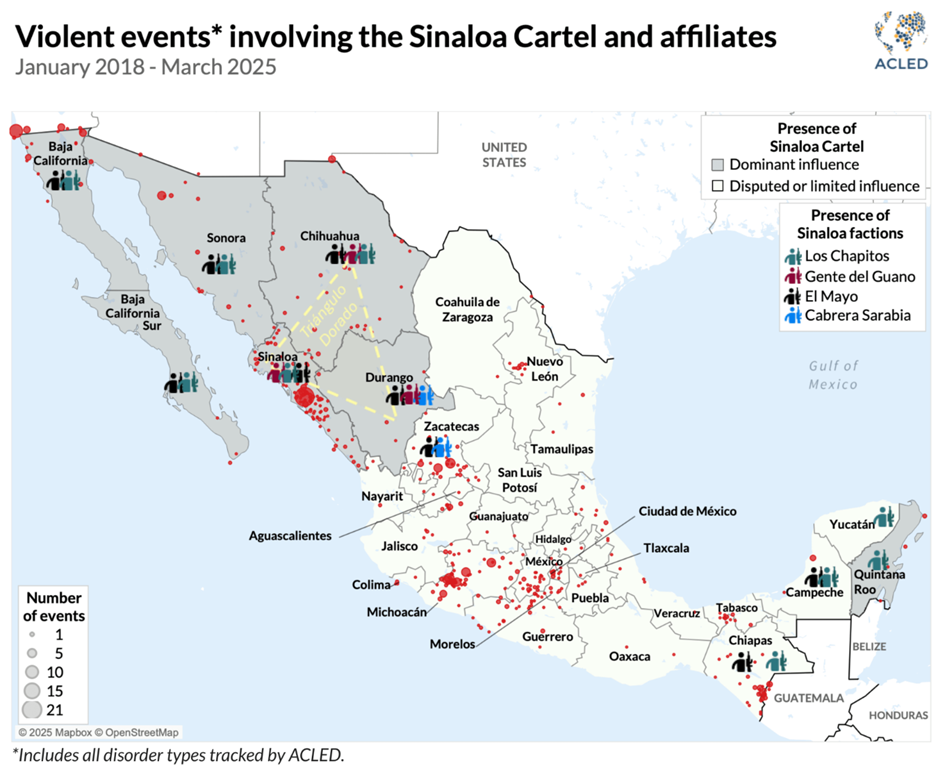
Although the Sinaloa Cartel could previously be apprehended as a whole under the concept of a decentralized organized armed group, since the rupture between the Mayiza and the Chapitos, the organization threshold must be assessed individually for both factions. Indeed, while until El Mayo’s arrest in July 2024, the Sinaloa Cartel succeeded in maintaining a relative unity, this cohesion then collapsed, giving rise to unprecedentedly intense fighting between the Mayiza and the Chapitos (see above and below). Other residual factions from Sinaloa cartel have also reportedly competed against these both main and now rival factions.83M. F. Arocha and S. Pellegrini, ‘How the Sinaloa Cartel rift is redrawing Mexico’s criminal map’, ACLED, 7 May 2025. Given the lack of available information on the organization of respective factions, for the time being, assessing whether they are sufficiently organized under IHL remains uncertain.
Intensity
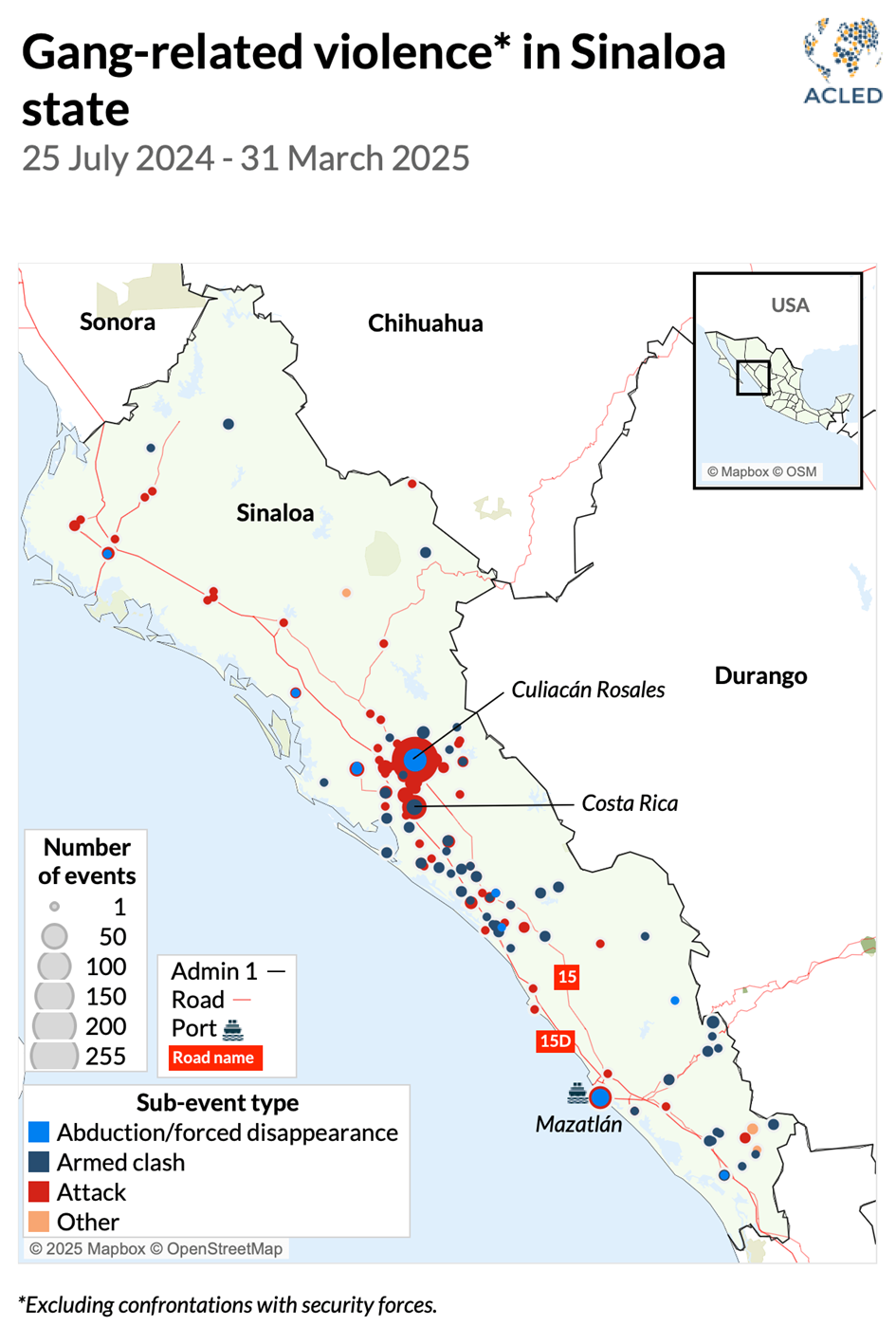
The clashes that broke out between the Chapitos and the Mayiza in September 2024 following El Mayo’s arrest have reached unprecedented level of violence in Mexico over the past six years.84M. F. Arocha and S. Pellegrini, ‘How the Sinaloa Cartel rift is redrawing Mexico’s criminal map’, ACLED, 7 May 2025. Initially concentrated in Sinaloa state (see above), the ongoing violence has also spread to other territories controlled and disputed by the Sinaloa Cartel, as other criminal groups have sought to exploit the cartel’s internal division to advance their own expansion, compounded by the current Mexican government’s renewed reliance on the ‘kingpin’ strategy (see above) amid renewed pressure from the Trump administration.85M. F. Arocha and S. Pellegrini, ‘How the Sinaloa Cartel rift is redrawing Mexico’s criminal map’, ACLED, 7 May 2025. Initially concentrated in Sinaloa state’s capital city, Culiacán, the fighting has since expanded into rural areas and also affected Sonora and Baja California amid increased disputes between respective allies.86M. F. Arocha and S. Pellegrini, ‘How the Sinaloa Cartel rift is redrawing Mexico’s criminal map’, ACLED, 7 May 2025. Between July 2024 and March 2025, both factions’ targeting of civilians and of rival members nearly quadrupled compared to the previous year, with a peak recorded between October and November 2024,87M. F. Arocha and S. Pellegrini, ‘How the Sinaloa Cartel rift is redrawing Mexico’s criminal map’, ACLED, 7 May 2025. and resulted in more than 2,800 deaths and 3,300 disappearances as of late February 2026.88P. Asmann and V. Dittmar, ‘The New Rules of Engagement in Sinaloa’s Latest Crime Wars’, InSight Crime, 21 April 2025; ‘Special Series: The Sinaloa Cartel’s Internal War’, InSight Crime; International Crisi Group, Tracking Conflict Worldwide: Mexico, February 2026. Notably, civilians have been targeted in retaliatory attacks on allegations of links to rival factions, and have also been kidnapped and forcibly disappeared to instil fear and extort ransoms. Local authorities have been further targeted to establish control over localities and reduce rivals’ influence.89M. F. Arocha and S. Pellegrini, ‘How the Sinaloa Cartel rift is redrawing Mexico’s criminal map’, ACLED, 7 May 2025. When designating the Sinaloa Cartel as a Foreign Terrorist Organization in February 2025, Trump administration emphasized its use of violence to ‘murder, kidnap, and intimidate civilians, government officials, and journalists’.90US Department of State, ‘Designation of International Cartels’, Fact sheet, 20 February 2025; US Department of State, Executive Order 13224, 20 February 2025.
In the past, among other cartels, the Sinaloa Cartel was reported to possess improvised armoured vehicles, .50 calibre anti-materiel and sniper rifles, grenades, small-calibre mortars, rocket launchers including with anti-armour munitions, man-portable air-defence systems (MANPADS), and machine guns. It was also known for its use of improvised explosive devices, ambushes against Mexican security and military forces, use of anti-personnel and anti-vehicle mines, and trenches and other obstacles in the battlespace.91J. P. Sullivan, ‘Crime wars: Operational perspectives on criminal armed groups in Mexico and Brazil’, International review of the Red Cross, No. 923, June 2023, pp 856 and 866. Presumably, the Chapitos and the Mayiza, as the two main Sinaloa factions, have retained substantial parts of this arsenal, even though information remains limited in this respect.
In sum, although the intensity threshold has been reached in relation to the spike in violence between the Chapitos and the Mayiza since 2024, persisting uncertainty as to whether the organization criterion is fulfilled individually by both factions does not allow us to conclude that a NIAC between the two main rival Sinaloa factions is ongoing.
State Parties
- Mexico
Non-State parties
- Jalisco Cartel New Generation (CJNG)
- Cartel de Santa Rosa de Lima (CSRL)
Other Non-State Actors
- Chapitos
- Mayiza
- 1S. Casey-Maslen, ‘Armed conflicts in Mexico’, The War Report: Armed Conflict in 2013, S. Casey-Maslen (ed.), Oxford University Press, 2014, pp 156–62.
- 2‘Mexico’s most powerful cartel has also been safest from prosecution’, Mexico News Daily, 17 September 2018; International Crisi Group, Tracking Conflict Worldwide: Mexico, (January 2018-December 2021).
- 3C. Woody, ‘Mexico’s biggest cartel is leaderless, and drug violence may be about to intensify’, Business Insider, 29 October 2016; P. Asmann, ‘Is the Jalisco Cartel Winning the Battle for Mexico’s Caribbean?’, InSight Crime, 11 July 2019.
- 4RULAC, ‘Mexico: Declassification of the Three Armed Conflicts Involving Drug Cartels on RULAC’, 12 December 2022.
- 5‘The Felix Gallardo organization (Guadalajara OCG)’, Wilson Center; C. Redaelli, ‘Engaging with drug lords: protecting civilians in Colombia, Mexico, and Honduras’, The War Report: Armed Conflict in 2014, A. Bellal (ed.), Oxford University Press, 2015, pp 521–22.
- 6E. G. Brun and G. Kotarska, ‘The Kingpin Strategy: More Violence, No Peace’, Royal United Services Institute (RUSI), 17 November 2022; .‘The Felix Gallardo organization (Guadalajara OCG)’, Wilson Center.
- 7P Asmann, ‘Mexico’s Zetas: From Criminal Powerhouse to Fragmented Remnants’, InSight Crime, 6 April 2018 ; P. Asmann, ‘Fragmentation: The Violent Tailspin of Mexico’s Dominant Cartels’, InSight Crime, 16 January 2019; E. G. Brun and G. Kotarska, ‘The Kingpin Strategy: More Violence, No Peace’, Royal United Services Institute (RUSI), 17 November 2022.
- 8P. Crocoran, ‘Mexico President Reprises Controversial Kingpin Strategy’, InSight Crime, 6 June 2017; P. Asmann, ‘Fragmentation: The Violent Tailspin of Mexico’s Dominant Cartels’, InSight Crime, 16 January 2019; E. G. Brun and G. Kotarska, ‘The Kingpin Strategy: More Violence, No Peace’, Royal United Services Institute (RUSI), 17 November 2022; C. Redaelli and C. Arévalo, ‘When Cartels Fight Back: El Mencho and the NIAC Question in Mexico’, Articles of War, 23 March 2026.
- 9DEA Museum, ‘Disrupt, Dismantle, And Destroy: The Kingpin Strategy’, 10 December 2020.
- 10C. Redaelli, ‘Engaging with drug lords: protecting civilians in Colombia, Mexico, and Honduras’, The War Report: Armed Conflict in 2014, A. Bellal (ed.), Oxford University Press, 2015, pp 522–23; P. Crocoran, ‘Mexico President Reprises Controversial Kingpin Strategy’, InSight Crime, 6 June 2017; P. Asmann, ‘Fragmentation: The Violent Tailspin of Mexico’s Dominant Cartels’, InSight Crime, 16 January 2019; E. G. Brun and G. Kotarska, ‘The Kingpin Strategy: More Violence, No Peace’, Royal United Services Institute (RUSI), 17 November 2022.
- 11P. Crocoran, ‘Mexico President Reprises Controversial Kingpin Strategy’, InSight Crime, 6 June 2017.
- 12E. G. Brun and G. Kotarska, ‘The Kingpin Strategy: More Violence, No Peace’, Royal United Services Institute (RUSI), 17 November 2022; ‘Zetas’, InSight Crime, 30 August 2024 (updated 17 February 2026).
- 13‘Dos carteles dominan la guerra de las drogas en México’, Informador, 7 October 2011; S. Casey-Maslen, ‘Armed conflicts in Mexico’, The War Report: Armed Conflict in 2013, S. Casey-Maslen (ed.), Oxford University Press, 2014, pp 160-161; C. Redaelli, ‘Engaging with drug lords: protecting civilians in Colombia, Mexico, and Honduras’, The War Report: Armed Conflict in 2014, A. Bellal (ed.), Oxford University Press, 2015, pp 521–22; P. Asmann, ‘Fragmentation: The Violent Tailspin of Mexico’s Dominant Cartels’, InSight Crime, 16 January 2019; E. G. Brun and G. Kotarska, ‘The Kingpin Strategy: More Violence, No Peace’, Royal United Services Institute (RUSI), 17 November 2022; ‘Zetas’, InSight Crime, 30 August 2024 (updated 17 February 2026).
- 14F. Naim, ‘Morocco Helps US Target Global Arms Network Linked to Mexican CJNG Cartel’, Morocco World News, 27 March 2026.
- 15C. Redaelli, ‘Engaging with drug lords: protecting civilians in Colombia, Mexico, and Honduras’, The War Report: Armed Conflict in 2014, A. Bellal (ed.), Oxford University Press, 2015, pp 523–24; D. Ore, ‘A Reuters special report: How Mexican narcos use remittances to wire U.S. drug profits home’, Reuters, 18 August 2023.
- 16S. Casey-Maslen, ‘Armed conflicts in Mexico’, The War Report: Armed Conflict in 2013, S. Casey-Maslen (ed.), Oxford University Press, 2014, pp 161–62; ‘Sinaloa Cartel’, InSight Crime, 19 May 2025 (updated 19 February 2026).
- 17DEA, ‘The Sinaloa Cartel’, Command & Control: Cartels.
- 18DEA, ‘The Sinaloa Cartel’, Command & Control: Cartels.
- 19‘Sinaloa Cartel’, InSight Crime, 19 May 2025 (updated 19 February 2026).
- 20‘Sinaloa Cartel’, InSight Crime, 19 May 2025 (updated 19 February 2026).
- 21Beltrán Leyva Organization’, InSight Crime, 6 October 2021; ‘Mayiza’, InSight Crime, 27 May 2025; ‘Sinaloa Cartel’, InSight Crime, 19 May 2025 (updated 19 February 2026).
- 22C. Woody, ‘ONE YEAR LATER: The rise and fall of ‘El Chapo’ Guzmán, the world’s most ambitious drug lord’, Business Insider, 11 July 2016.
- 23‘Joaquín Guzmán Loera, alias ‘El Chapo’’, InSight Crime, 20 March 2019.
- 24‘Dámaso López Núñez, alias ‘Licenciado’’, InSight Crime, 9 July 2018.
- 25‘Sinaloa Cartel’, InSight Crime, 19 May 2025 (updated 19 February 2026).
- 26‘Dámaso López Núñez, alias ‘Licenciado’’, InSight Crime, 9 July 2018.
- 27S. Casey-Maslen, ‘Armed conflicts in Mexico’, The War Report: Armed Conflict in 2013, S. Casey-Maslen (ed.), Oxford University Press, 2014, pp 161–62.
- 28A. A. Caldwell and M. Stevenson, ‘AP Exclusive: Sinaloa cartel wins Juarez turf war’, The Seattle Times, 9 April 2010.
- 29‘Beltrán Leyva Organization’, InSight Crime, 6 October 2021; ‘Sinaloa Cartel’, InSight Crime, 19 May 2025 (updated 19 February 2026).
- 30‘Sinaloa Cartel’, InSight Crime, 19 May 2025 (updated 19 February 2026).
- 31‘Dámaso López Núñez, alias ‘Licenciado’’, InSight Crime, 9 July 2018.
- 32‘Dámaso López Núñez, alias ‘Licenciado’’, InSight Crime, 9 July 2018.
- 33L. Goi, ‘Internal Cartel Conflict Could Be Behind Spike in Western Mexico Violence’, InSight Crime, 9 February 2017; P. Asmann, ‘Fragmentation: The Violent Tailspin of Mexico’s Dominant Cartels’, InSight Crime, 16 January 2019.
- 34‘Sinaloa Cartel’, InSight Crime, 19 May 2025 (updated 19 February 2026).
- 35M. F. Arocha and S. Pellegrini, ‘How the Sinaloa Cartel rift is redrawing Mexico’s criminal map’, ACLED, 7 May 2025; ‘Sinaloa Cartel’, InSight Crime, 19 May 2025 (updated 19 February 2026).
- 36‘The New Criminal Group Hitting Mexico’s CJNG Where It Hurts’, InSight Crime, 24 July 2018.
- 37DEA, ‘The Jalisco New Generation Cartel’, Command & Control: Cartels; ‘Cártel de Jalisco, herencia de Ignacio ‘“Nacho’” Coronel’, El Informador, 8 October 2011; ‘Jalisco Cartel New Generation (CJNG)’, InSight Crime, 23 February 2026; C. Flores, ‘Will Mexico’s Jalisco cartel’s violent biz model survive El Mencho’s death?’, Al Jazeera, 25 February 2026.
- 38DEA, ‘The Jalisco New Generation Cartel’, Command & Control: Cartels; ‘Jalisco Cartel New Generation (CJNG)’, InSight Crime, 23 February 2026.
- 39‘Jalisco Cartel New Generation (CJNG)’, InSight Crime, 23 February 2026; ‘Who was El Mencho, the former police officer who co-founded an ultraviolent cartel in Mexico?’, The Guardian, 23 February 2026.
- 40‘Mexico declares all-out war after rising drug cartel downs military helicopter’, The Guardian, 5 May 2015; ‘‘An atmosphere of terror’: the bloody rise of Mexico’s top cartel’, The Guardian, 2 April 2021; S. Pellegrini and M. F. Arocha, ‘Actor Profile: The Jalisco New Generation Cartel (CJNG)’, ACLED, 14 April 2023; ‘Jalisco Cartel New Generation (CJNG)’, InSight Crime, 23 February 2026; C. Flores, ‘Will Mexico’s Jalisco cartel’s violent biz model survive El Mencho’s death?’, Al Jazeera, 25 February 2026; F. Naim, ‘Morocco Helps US Target Global Arms Network Linked to Mexican CJNG Cartel’, Morocco World News, 27 March 2026.
- 41P. Asmann, ‘Masacre en Veracruz remata sangriento inicio de 2019 en México’, InSight Crime, 24 April 2019; S. Henkin, ‘Tracking Cartels Infographic Series: The Violent Rise of Cártel de Jalisco Nuevo Generación (CJNG)’, START, June 2020.
- 42‘Mexico declares all-out war after rising drug cartel downs military helicopter’, The Guardian, 5 May 2015; ‘Who was El Mencho, the former police officer who co-founded an ultraviolent cartel in Mexico?’, The Guardian, 23 February 2026. See also: C. Flores, ‘Will Mexico’s Jalisco cartel’s violent biz model survive El Mencho’s death?’, Al Jazeera, 25 February 2026.
- 43See also: S. Pellegrini and M. F. Arocha, ‘Actor Profile: The Jalisco New Generation Cartel (CJNG)’, ACLED, 14 April 2023.
- 44DEA, ‘The Jalisco New Generation Cartel’, Command & Control: Cartels; ‘Who was El Mencho, the former police officer who co-founded an ultraviolent cartel in Mexico?’, The Guardian, 23 February 2026.
- 45DEA, ‘The Jalisco New Generation Cartel’, Command & Control: Cartels; S. Henkin, ‘Tracking Cartels Infographic Series: The Violent Rise of Cártel de Jalisco Nuevo Generación (CJNG)’, START, June 2020; S. Pellegrini and M. F. Arocha, ‘Actor Profile: The Jalisco New Generation Cartel (CJNG)’, ACLED, 14 April 2023; P. Asmann, ‘What’s Next for Mexico’s CJNG After the Killing of ‘El Mencho’? ‘, InSight Crime, 23 February 2026; C. Flores, ‘Will Mexico’s Jalisco cartel’s violent biz model survive El Mencho’s death?’, Al Jazeera, 25 February 2026; C. Redaelli and C. Arévalo, ‘When Cartels Fight Back: El Mencho and the NIAC Question in Mexico’, Articles of War, 23 March 2026.
- 46‘Sinaloa Cartel’, InSight Crime, 19 May 2025 (updated 19 February 2026).
- 47‘Cartel de Santa Rosa de Lima (CSRL)’, InSight Crime, 19 September 2025; US Department of the Treasury, ‘Secretary Bessent Orders Sanctions Against Violent Mexican Cartel’, Press release, 17 December 2025.
- 48‘Cartel de Santa Rosa de Lima (CSRL)’, InSight Crime, 19 September 2025.
- 49‘Cartel de Santa Rosa de Lima (CSRL)’, InSight Crime, 19 September 2025.
- 50C. Dalby, ‘Three Takeaways from the Capture of ‘El Marro’ in Mexico’, InSight Crime, 5 August 2020; ‘Cartel de Santa Rosa de Lima (CSRL)’, InSight Crime, 19 September 2025.
- 51‘Cartel de Santa Rosa de Lima (CSRL)’, InSight Crime, 19 September 2025.
- 52‘Cartel de Santa Rosa de Lima (CSRL)’, InSight Crime, 19 September 2025.
- 53‘Cartel de Santa Rosa de Lima (CSRL)’, InSight Crime, 19 September 2025.
- 54‘Cartel de Santa Rosa de Lima (CSRL)’, InSight Crime, 19 September 2025; US Department of the Treasury, ‘Secretary Bessent Orders Sanctions Against Violent Mexican Cartel’, Press release, 17 December 2025.
- 55V. Buschschlüter, ‘Gunmen storm Mexico football pitch and kill at least 11 people’, BBC, 26 January 2026.
- 56‘El Cártel de Sinaloa apoyaría con armamento al Santa Rosa de Lima en Guanajuato, revelaron las autoridades’, infobae, 22 September 2020; ‘Detienen en México a persona ligada a masacre en un bar en el centro del país en 2024’, SwissInfo, 22 August 2025; ‘Cartel de Santa Rosa de Lima (CSRL)’, InSight Crime, 19 September 2025; US Department of the Treasury, ‘Secretary Bessent Orders Sanctions Against Violent Mexican Cartel’, Press release, 17 December 2025.
- 57US Presidential Document, Executive Order 14157, Federal Register: The Daily Journal of the United States Government, 20 January 2025; US State Department, ‘Foreign Terrorist Organization Designations of Tren de Aragua, Mara Salvatrucha, Cartel de Sinaloa, Cartel de Jalisco Nueva Generacion, Carteles Unidos, Cartel del Noreste, Cartel del Golfo, and La Nueva Familia Michoacana’, Federal Register: The Daily Journal of the United States Government, 2 February 2025.
- 58‘Cartel de Santa Rosa de Lima (CSRL)’, InSight Crime, 19 September 2025.
- 59US Department of the Treasury, ‘Secretary Bessent Orders Sanctions Against Violent Mexican Cartel’, Press release, 17 December 2025.
- 60‘5 CJNG Hotspots to Watch After El Mencho’s Killing in Mexico’, InSight Crime, 24 February 2026.
- 61P. Asmann and V. Dittmar, ‘The New Rules of Engagement in Sinaloa’s Latest Crime Wars’, InSight Crime, 21 April 2025; ‘Sinaloa Cartel’, InSight Crime, 19 May 2025 (updated 19 February 2026); C. Redaelli and C. Arévalo, ‘When Cartels Fight Back: El Mencho and the NIAC Question in Mexico’, Articles of War, 23 March 2026.
- 62Institute for Economics & Peace, Global Peace Index 2025, p. 20; ‘Mayiza’, InSight Crime, 27 May 2025; P. Asmann and V. Dittmar, ‘The New Rules of Engagement in Sinaloa’s Latest Crime Wars’, InSight Crime, 21 April 2025; International Crisi Group, Tracking Conflict Worldwide: Mexico, February 2026; C. Redaelli and C. Arévalo, ‘When Cartels Fight Back: El Mencho and the NIAC Question in Mexico’, Articles of War, 23 March 2026.
- 63P. Asmann and V. Dittmar, ‘The New Rules of Engagement in Sinaloa’s Latest Crime Wars’, InSight Crime, 21 April 2025.
- 64. C. Redaelli and C. Arévalo, ‘When Cartels Fight Back: El Mencho and the NIAC Question in Mexico’, Articles of War, 23 March 2026. As observed by the authors, Mexico has been criticized in the past by the Inter-American Court of Human Rights (IACHR) for over-relying on military deployments instead of civilian police operations for public security. See: IACHR, Case of Alvarado Espinoza et al. v. Mexico, Judgment, 28 November 2018.
- 65S. Pellegrini, ‘Mexico: El Mencho’s killing triggers nationwide escalation — Expert comment’, ACLED, 23 February 2026.
- 66S. Collinson, ‘A cartel crackdown carries political risks for Trump’, CNN Politics, 24 February 2026; V. Buschschlüter, ‘Gunmen storm Mexico football pitch and kill at least 11 people’, BBC, 26 January 2026.
- 67V. Buschschlüter, ‘Gunmen storm Mexico football pitch and kill at least 11 people’, BBC, 26 January 2026.
- 68F. Naim, ‘Morocco Helps US Target Global Arms Network Linked to Mexican CJNG Cartel’, Morocco World News, 27 March 2026.
- 69C. Redaelli and C. Arévalo, ‘When Cartels Fight Back: El Mencho and the NIAC Question in Mexico’, Articles of War, 23 March 2026.
- 70‘Key events in Mexican operation to capture cartel leader ‘El Mencho’’, Reuters, 23 February 2026; ‘El Mencho: Mexico officials say 25 soldiers killed after cartel raid’, Al Jazeera, 23 February 2026.
- 71C. Redaelli and C. Arévalo, ‘When Cartels Fight Back: El Mencho and the NIAC Question in Mexico’, Articles of War, 23 March 2026.
- 72ICTY, Prosecutor v Dusko Tadić, Appeals Chamber, Decision on the Defence Motion for Interlocutory Appeal on Jurisdiction, Case No IT-94-1-AR72, 2 October 1995, para 70; ICTY, Prosecutor v Dusko Tadić, Trial Chamber, Judgment, Case No IT-94-1-T, 7 May 1997, para 562.
- 73For a summary, see ICTY, Prosecutor v Ljube Boškoski and Johan Tarčulovski, Trial Chamber, Judgment, Case No IT-04-82-T, 10 July 2008, para 177.
- 74For a summary, see ICTY, Prosecutor v Ramush Haradinaj and others, Trial Chamber, Judgment, Case No IT-04-84-T, 3 April 2008, para 60.
- 75ICTY, Prosecutor v Fatmir Limaj et al., Judgment (Trial Chamber) (Case No. IT-03-66-T), 30 November 2005, para 170.]
- 76C. Redaelli and C. Arévalo, ‘When Cartels Fight Back: El Mencho and the NIAC Question in Mexico’, Articles of War, 23 March 2026.
- 77M. F. Arocha and S. Pellegrini, ‘How the Sinaloa Cartel rift is redrawing Mexico’s criminal map’, ACLED, 7 May 2025; ‘Sinaloa Cartel’, InSight Crime, 19 May 2025 (updated 19 February 2026).
- 78M. F. Arocha and S. Pellegrini, ‘How the Sinaloa Cartel rift is redrawing Mexico’s criminal map’, ACLED, 7 May 2025; ‘Sinaloa Cartel’, InSight Crime, 19 May 2025 (updated 19 February 2026).
- 79J. P. Sullivan, ‘Crime wars: Operational perspectives on criminal armed groups in Mexico and Brazil’, International Review of the Red Cross, No. 923 (June 2023), p 856.
- 80‘Sinaloa Cartel’, InSight Crime, 19 May 2025 (updated 19 February 2026); ‘Chapitos’, InSight Crime, 19 May 2025; ‘Mayiza’, InSight Crime, 27 May 2025.
- 81‘Mayiza’, InSight Crime, 27 May 2025.
- 82M. F. Arocha and S. Pellegrini, ‘How the Sinaloa Cartel rift is redrawing Mexico’s criminal map’, ACLED, 7 May 2025; ‘Chapitos’, InSight Crime, 19 May 2025.
- 83M. F. Arocha and S. Pellegrini, ‘How the Sinaloa Cartel rift is redrawing Mexico’s criminal map’, ACLED, 7 May 2025.
- 84M. F. Arocha and S. Pellegrini, ‘How the Sinaloa Cartel rift is redrawing Mexico’s criminal map’, ACLED, 7 May 2025.
- 85M. F. Arocha and S. Pellegrini, ‘How the Sinaloa Cartel rift is redrawing Mexico’s criminal map’, ACLED, 7 May 2025.
- 86M. F. Arocha and S. Pellegrini, ‘How the Sinaloa Cartel rift is redrawing Mexico’s criminal map’, ACLED, 7 May 2025.
- 87M. F. Arocha and S. Pellegrini, ‘How the Sinaloa Cartel rift is redrawing Mexico’s criminal map’, ACLED, 7 May 2025.
- 88P. Asmann and V. Dittmar, ‘The New Rules of Engagement in Sinaloa’s Latest Crime Wars’, InSight Crime, 21 April 2025; ‘Special Series: The Sinaloa Cartel’s Internal War’, InSight Crime; International Crisi Group, Tracking Conflict Worldwide: Mexico, February 2026.
- 89M. F. Arocha and S. Pellegrini, ‘How the Sinaloa Cartel rift is redrawing Mexico’s criminal map’, ACLED, 7 May 2025.
- 90US Department of State, ‘Designation of International Cartels’, Fact sheet, 20 February 2025; US Department of State, Executive Order 13224, 20 February 2025.
- 91J. P. Sullivan, ‘Crime wars: Operational perspectives on criminal armed groups in Mexico and Brazil’, International review of the Red Cross, No. 923, June 2023, pp 856 and 866.